The $2.4 Million Problem Most Companies Don't Even Know They Have
Discover why companies lose millions through organizational memory loss, poor documentation, and disconnected knowledge—and how modern AI can solve it.

Your biggest business risk isn't AI.
It isn't cybersecurity.
It isn't hiring.
It's organizational memory loss.
Imagine This...
It's Monday morning.
At 9:17 AM, your most experienced engineer submits their resignation.
Nobody panics.
After all...
- The documentation exists.
- GitHub repositories are intact.
- Slack history is searchable.
- Jira tickets are completed.
- Meeting recordings are stored.
Everything seems safe.
Three months later...
A production incident brings your engineering team to a halt.
Someone asks:
"Why was this architecture designed this way?"
Silence.
The engineer who made that decision has already left.
The Slack thread is buried beneath 300,000 messages.
The Jira ticket simply says Done.
The GitHub Pull Request explains what changed.
Not why it changed.
And that's when companies realize they never lost their data.
They lost their memory.
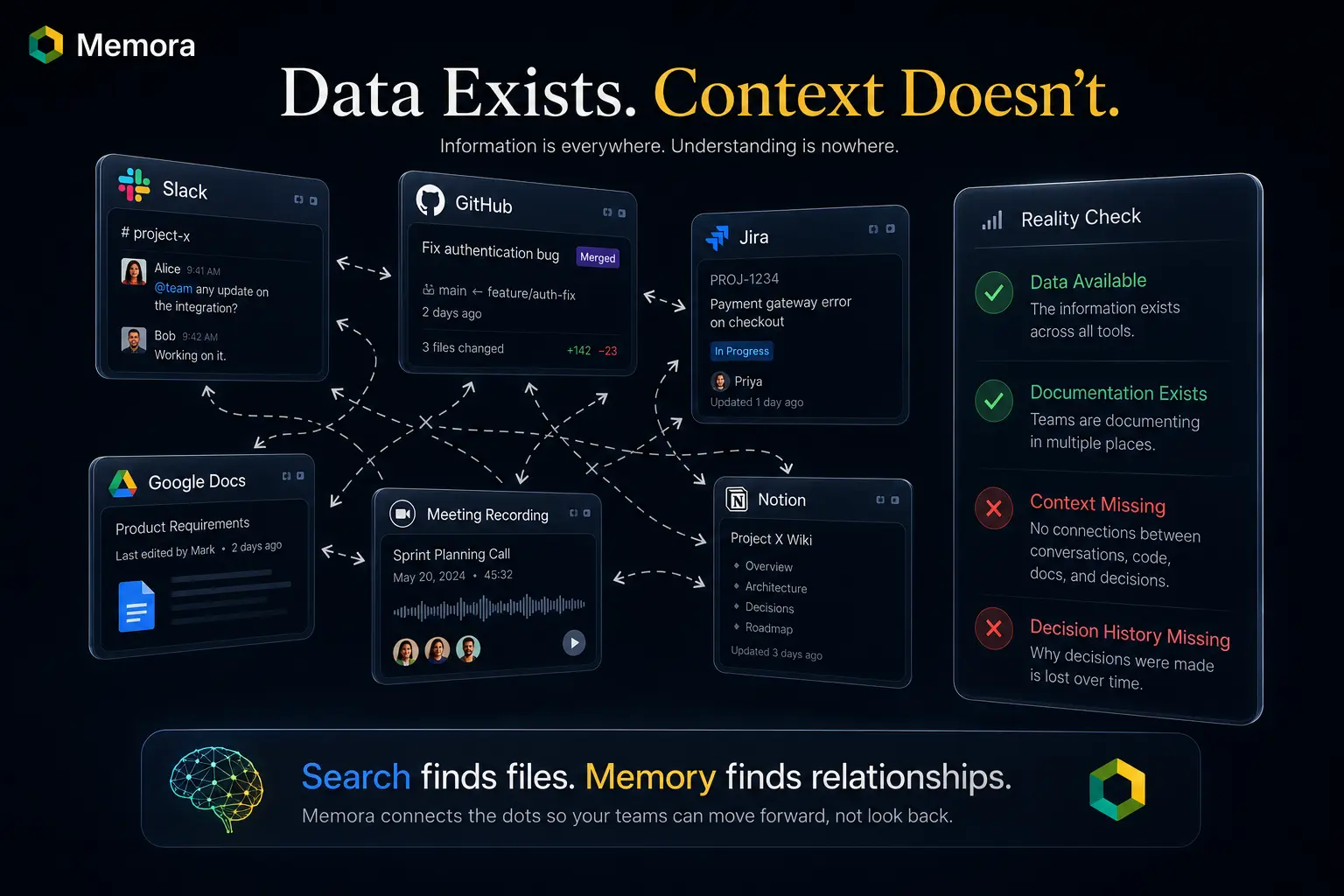 Engineer searching through scattered company knowledge
Companies Aren't Losing Data.
They're Losing Context.
Modern companies generate more information than ever before.
Every single day, teams create knowledge across dozens of platforms.
- Slack conversations
- GitHub Pull Requests
- Jira Issues
- Notion Pages
- Confluence Documentation
- Google Docs
- Figma Comments
- Zoom Meetings
- Google Meet Recordings
- Email Threads
The problem isn't missing information.
The problem is that every decision is fragmented across different systems.
Traditional search can find files.
It cannot reconstruct the story behind a decision.
The Hidden Cost Nobody Calculates
Every leadership team tracks metrics like:
- Customer Acquisition Cost (CAC)
- Cloud Infrastructure Cost
- Engineering Velocity
- Burn Rate
- Employee Retention
Almost nobody measures:
Knowledge Loss Cost.
According to research by the Organizational Amnesia Project, companies lose billions every year because employees spend significant time searching for information instead of doing productive work.
Read more: https://organizationalamnesia.com/
Likewise, McKinsey & Company has reported that knowledge workers spend a meaningful portion of their workweek simply searching for internal information rather than creating value.
Research: https://www.mckinsey.com/capabilities/people-and-organizational-performance
Think about that.
Your engineers aren't slow.
Your documentation isn't necessarily bad.
Your company simply forgot where its knowledge lives.
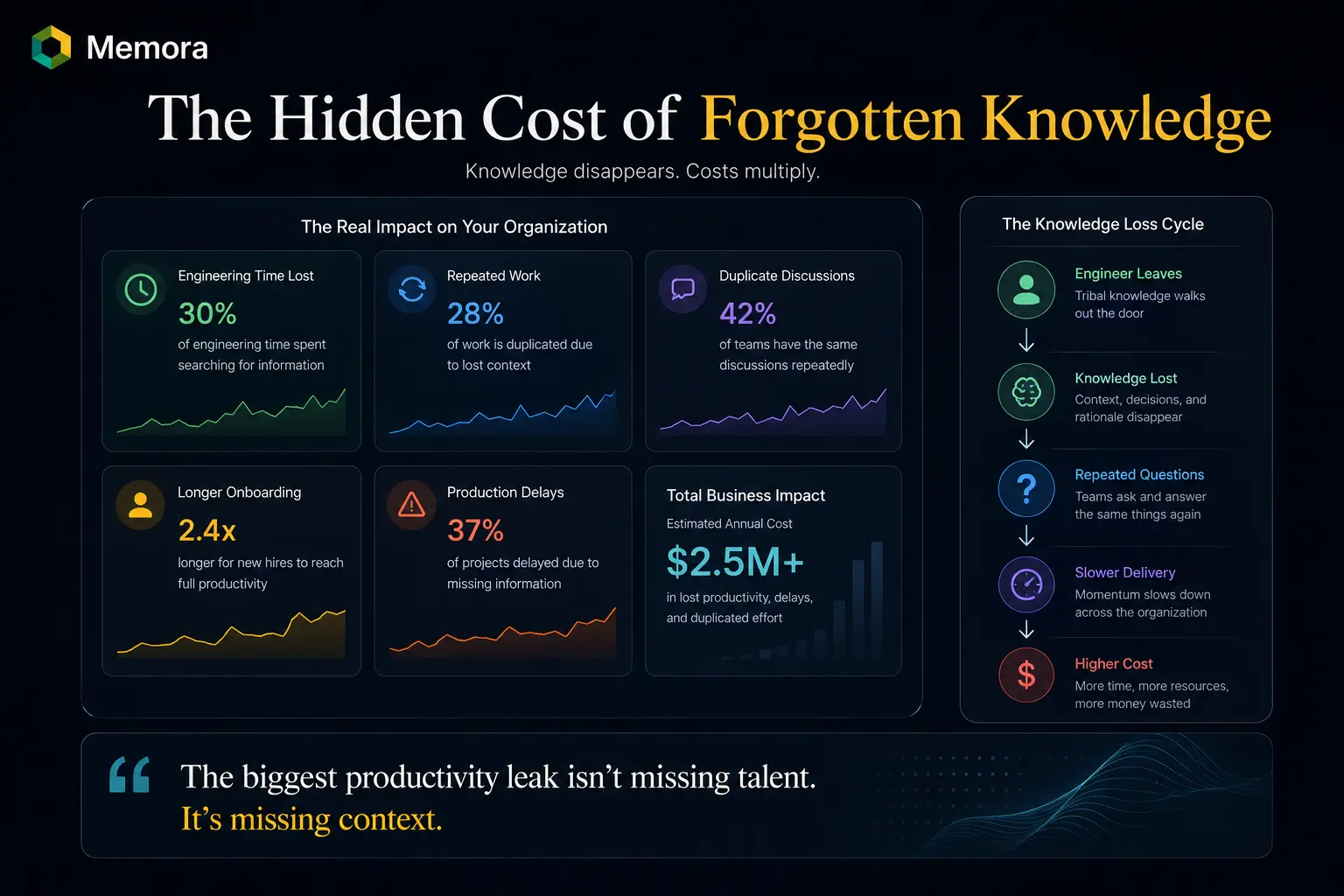 Organizational memory breaking apart into disconnected tools
Documentation Isn't the Problem
Many companies believe they simply need:
- More documentation
- Better documentation
- Updated documentation
Unfortunately...
Documentation only tells you what happened.
Rarely does it explain:
- Why was Redis rejected?
- Why did the team migrate to GraphQL?
- Who approved the architecture?
- Which production incident caused the redesign?
- Why was Feature X postponed?
- Which customer influenced the decision?
Those answers usually exist inside:
- Slack discussions
- Design meetings
- Architecture reviews
- Pull Request conversations
- Incident retrospectives
Documentation captures outcomes.
Organizational memory captures reasoning.
AI Didn't Solve This Problem
Many organizations rushed to integrate AI assistants.
ChatGPT.
Copilot.
Claude.
Gemini.
But employees still ask:
"Who knows this system?"
Why?
Because AI can only answer using the context it receives.
Disconnected knowledge produces disconnected answers.
Recent industry analysis explains that organizations are facing an AI memory crisis—AI retrieves information but still struggles to connect historical decisions across fragmented systems.
Read the article:
https://www.techradar.com/pro/britains-ai-push-is-exposing-a-memory-crisis-inside-business
AI without organizational memory becomes a better search engine.
Not a better teammate.
Search Finds Files.
Memory Finds Answers.
Imagine asking:
Why did we migrate from REST to gRPC?
Traditional Search returns:
- 17 Documents
- 4 GitHub PRs
- 8 Slack Threads
- 2 Meeting Recordings
Memora returns:
✅ The original architecture proposal
✅ Slack discussion
✅ Design document
✅ Meeting transcript
✅ GitHub Pull Request
✅ Jira Epic
✅ Production deployment
✅ Follow-up bug fixes
Everything connected.
Everything traceable.
Everything explained.
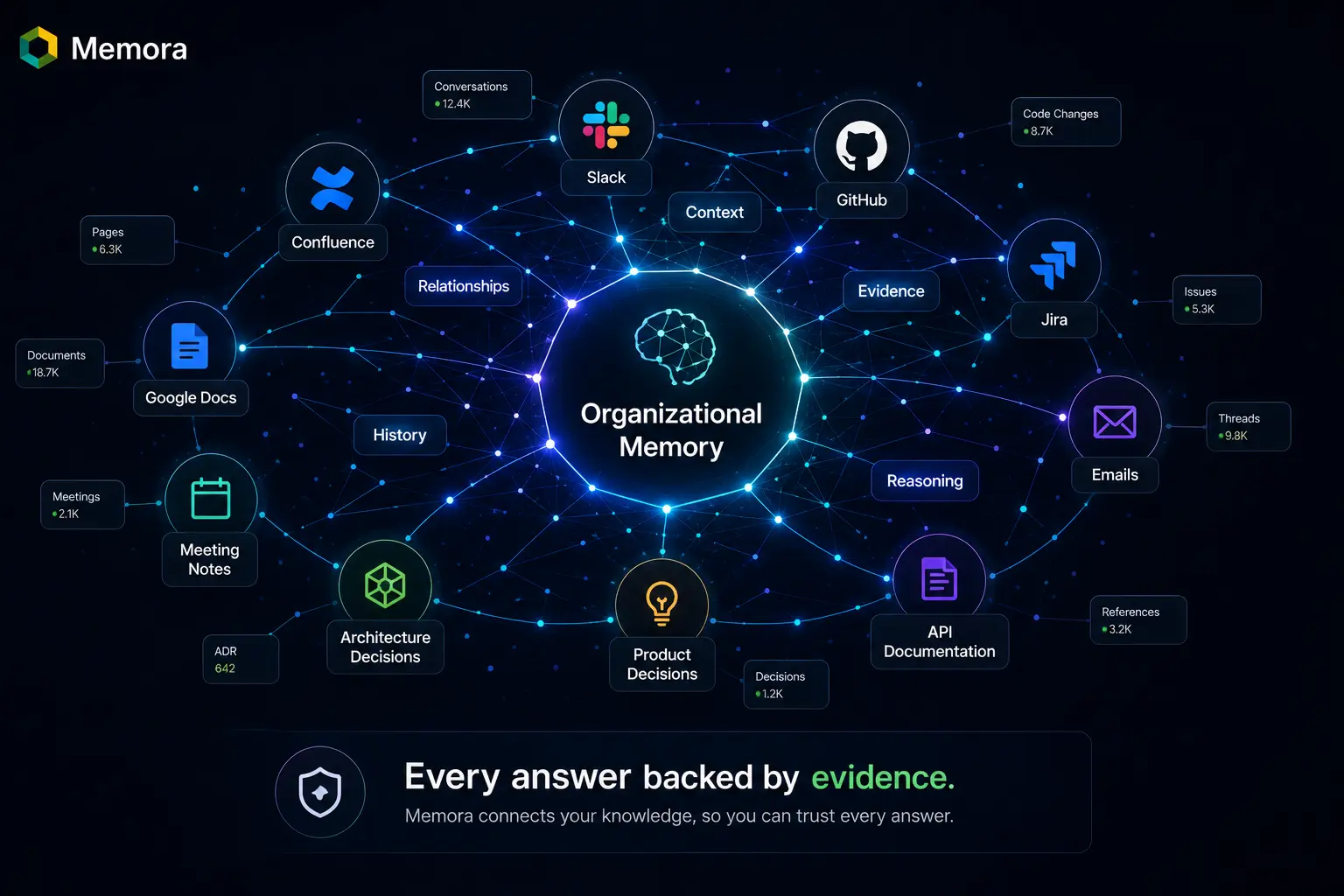 Knowledge graph connecting Slack, GitHub, Jira and Meetings
Organizational Memory Is Becoming a Competitive Advantage
The companies that move fastest aren't the ones writing the most documentation.
They're the ones preserving context.
Imagine onboarding a new engineer.
Instead of asking ten teammates:
"Why does this microservice exist?"
They simply ask Memora.
Within seconds they receive:
- The answer
- Supporting evidence
- Linked documents
- Original discussions
- Meeting decisions
This isn't documentation.
This is institutional memory.
Introducing Memora
Memora is an Organizational Memory Engine.
It continuously connects knowledge across:
- Slack
- GitHub
- Jira
- Notion
- Google Drive
- Confluence
- Meeting Transcripts
- Internal Documentation
- Product Decisions
- Architecture Discussions
Instead of becoming another knowledge base...
It builds a living memory for your company.
Every answer is backed by evidence.
Every conclusion links to its source.
So you can check it.
Instead of guessing, you get traceable organizational knowledge.
Why This Matters More Than Ever
AI is changing how companies work.
Remote work is changing where knowledge lives.
Teams are becoming more distributed.
Employee turnover continues.
Information grows exponentially.
Without organizational memory...
Every resignation becomes a knowledge leak.
Every forgotten decision becomes technical debt.
Every repeated discussion wastes engineering time.
Related Reading
Want to learn more?
-
What Is Organizational Memory? https://memora.company/blog/what-is-organizational-memory
-
Graph RAG Explained https://memora.company/blog/graph-rag-explained
-
Enterprise Search vs Organizational Memory https://memora.company/blog/enterprise-search-vs-organizational-memory
-
AI Meeting Notes: Beyond Simple Transcripts https://memora.company/blog/ai-meeting-notes
Final Thoughts
People leave.
Projects evolve.
Documentation becomes outdated.
But your company's knowledge shouldn't disappear.
The future belongs to organizations that remember.
The question isn't whether your company has knowledge.
The question is:
Can your company still explain today's decisions two years from now?
If the answer is no...
It's time to build an organizational memory.
Ready to Build Your Company's Second Brain?
Discover how Memora transforms scattered conversations, meetings, documentation, and code into a living organizational memory.
Explore Memora's foundational guides on Graph RAG, persistent AI memory, and automated knowledge discovery:
Why do standard vector search systems fail on complex technical context?